
PEP: HIV Post-Exposure Prophylaxis
This article is educational content based on current peer-reviewed guidelines, including the Southern African HIV Clinicians Society 2023 PEP Guideline. It is not personalised medical advice. PEP decisions depend on the specific exposure, the exposed person's health, and timing, and must be made in consultation with a doctor. If you think you've had a possible HIV exposure, call the practice or go to your nearest emergency unit. Do not wait.
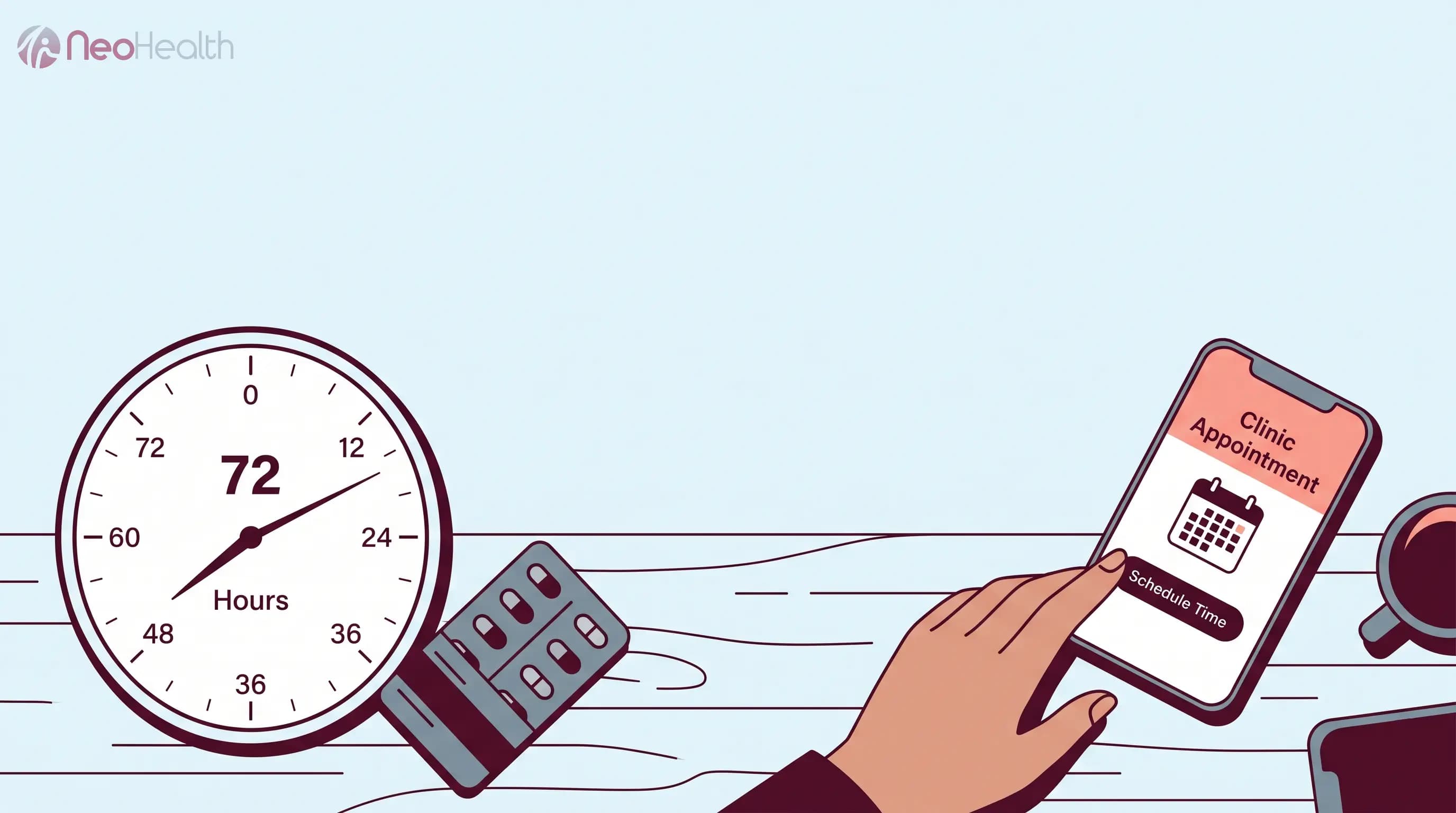
Time-sensitive: if you may have been exposed to HIV in the last 72 hours, PEP works best the sooner it starts. Call the practice or book an urgent telehealth consult today; PEP can often be assessed and started the same day, in person or by telehealth. If you cannot reach us, go to your nearest emergency department or HIV clinic immediately. All enquiries are confidential.
Key points
- The 72-hour window is a hard deadline. Animal evidence shows PEP efficacy drops sharply after 72 hours. Earlier is always better.
- PEP is 28 days of combination antiretroviral medication. Current South African first-line is tenofovir with lamivudine and dolutegravir (TLD) as a single tablet once daily.
- PEP is an emergency intervention, not a judgment. Occupational exposure, sexual exposure, sharing injection equipment, and sexual assault are all valid reasons to seek PEP.
- PEP is NOT indicated when the source is known to be virally suppressed on treatment, when the exposure was low-risk (kissing, intact skin, non-infectious fluids), or when it has been more than 72 hours.
- Confidentiality at NeoHealth. PEP consultations are booked and billed as routine, with no special coding. For privacy reasons, please call the practice rather than WhatsApp for PEP enquiries.
If you think you've had a possible HIV exposure, act now:
- The 72-hour clock started at the moment of possible exposure, not at the moment you notice.
- During practice hours, book an urgent consultation or call the practice.
- Outside practice hours, go to your nearest emergency unit. Most public and private emergency departments in George initiate PEP 24/7.
- Do not wait to "see if it was really an exposure". Start the conversation now. Stopping PEP early is easier than starting late.
What PEP actually is
PEP is a 28-day course of antiretroviral medication taken after a possible HIV exposure, to prevent HIV from establishing infection. It is the same kind of medication used to treat HIV, taken preventively in a narrow emergency window.
The principle is time-sensitive. HIV needs a few days after entering the body to establish a persistent infection. In that early window the virus is replicating locally and entering the bloodstream, but has not yet embedded itself in long-term immune cells. If antiretroviral medication is started early enough, it blocks replication and the immune system clears what is left before HIV can take hold.
PEP is not a morning-after pill for HIV, and it is not 100% effective. But when it is started early and taken correctly for the full 28 days, it significantly reduces the risk of HIV acquisition. The Southern African HIV Clinicians Society classifies all potential HIV exposures as medical emergencies. Every hour counts. 72 hours is the hard deadline.
The 72-hour window: why timing matters
Current guidance from the Southern African HIV Clinicians Society, the CDC, and the World Health Organization all state that PEP must be started within 72 hours of the possible exposure, and the earlier within that window, the better.
The 72-hour figure is not arbitrary. It comes from animal studies: in primate research, PEP started within 12 to 36 hours of exposure prevented all infections. Efficacy dropped significantly when treatment was delayed to 72 hours. Beyond 72 hours, PEP was essentially ineffective.
Earlier intervention is better at every hour:
- Within 4 hours: optimal
- Within 24 hours: strong
- Within 48 hours: good
- 48 to 72 hours: still worthwhile
- After 72 hours: no longer recommended as standard PEP
If you are within the window, start. If you are close to the deadline, go faster. If you are just past 72 hours, it is still worth a conversation. Some situations (very high-risk exposure, specific clinical circumstances) may warrant extended PEP assessment or alternative strategies, but this is a clinician decision. Go to an emergency unit or call the practice immediately.
When PEP is indicated
PEP is indicated for any significant exposure where HIV transmission is possible and the exposure was within 72 hours. The SAHCS 2023 Guideline frames this as substantial-risk exposure when the source is known to have HIV without sustained viral suppression, or when the source's HIV status is unknown.
Estimated per-act HIV transmission risk from different exposures (per 10,000 exposures):
- Receptive anal intercourse without a condom: 138 per 10,000 (approximately 1.38%)
- Insertive anal intercourse without a condom: 11 per 10,000
- Receptive vaginal intercourse without a condom: 8 per 10,000
- Insertive vaginal intercourse without a condom: 4 per 10,000
- Sharing injection equipment: 63 per 10,000
- Percutaneous (needlestick) exposure in healthcare: 23 per 10,000 (approximately 0.3%)
Specific scenarios where PEP is commonly indicated include:
- Occupational exposure: needlestick injury with a hollow-bore needle that has been used in a vein or artery, particularly if there is visible blood on the instrument; mucous membrane splash with blood or body fluid.
- Non-occupational sexual exposure: condomless penetrative sex (anal or vaginal) with a partner whose HIV status is unknown or who is known to have HIV without sustained viral suppression; condom failure during sex; sexual assault.
- Sharing injection equipment with a person whose HIV status is unknown or who is known to have HIV with detectable viral load.
- Other percutaneous exposure to HIV-infected blood, including human bites that break the skin in specific circumstances.
The principle is that any exposure to potentially infectious body fluids from a person whose HIV status might be unsuppressed warrants an urgent clinical assessment.
When PEP is NOT indicated
PEP is not helpful in some scenarios. It is not withheld as judgment; it is simply not effective or not needed:
- Source with sustained viral suppression. If the source person is known to have been on HIV treatment for longer than 6 months with consistent adherence and a confirmed viral load under 1,000 copies/mL (or undetectable), the transmission risk is extremely low, and PEP is generally not recommended. This is the U=U (Undetectable = Untransmittable) principle.
- Exposure beyond 72 hours. The window for effective PEP has closed.
- Exposure to non-infectious fluids only. Saliva (without blood), sputum, tears, sweat, urine and stool do not transmit HIV.
- Exposure to infectious fluid on intact skin only. Without broken skin or mucous membrane contact, HIV cannot enter.
- Consistent and correct condom use throughout sex. Even if the condom was in contact with fluids, an intact condom blocks transmission.
- The exposed person is already living with HIV. PEP is not used for people already HIV-positive.
- The exposed person is already taking PrEP as prescribed. Correctly-taken PrEP is highly effective; additional PEP is not generally required. Exceptions: recent PrEP initiation, missed PrEP doses, or exposure to a source known to have drug-resistant HIV.
Being told PEP is not indicated is not a dismissal. It means the exposure does not carry enough transmission risk to justify a 28-day course of antiretroviral medication. Regardless, the consultation is still an opportunity to discuss ongoing HIV prevention, including PrEP if appropriate, and to screen for other sexually transmitted infections and hepatitis.
The current first-line regimen in South Africa
The South African HIV Clinicians Society 2023 Guideline recommends a three-drug combination for PEP in adults and adolescents weighing 30 kg or more:
Tenofovir disoproxil fumarate (TDF) 300 mg + lamivudine (3TC) 300 mg + dolutegravir (DTG) 50 mg, taken as a single fixed-dose combination tablet once daily for 28 days. This regimen is commonly known as TLD.
This is the same regimen used as first-line HIV treatment. The rationale is that TLD is highly effective, well tolerated, and available as a single tablet, which significantly improves adherence over the 28-day course. Dolutegravir also acts rapidly to suppress viral replication, which is precisely what PEP needs to do.
Alternative regimens are used in specific situations:
- Renal impairment (reduced kidney function): tenofovir alafenamide (TAF) may be used instead of TDF, or, in severe impairment, zidovudine (AZT) may be substituted. Dose adjustments are required.
- Where dolutegravir cannot be used (rare, usually specific drug interactions): a protease inhibitor such as atazanavir/ritonavir or lopinavir/ritonavir may be used as the third agent. These are less well tolerated.
- For people taking rifampicin (for tuberculosis) or carbamazepine (for epilepsy): dolutegravir dose needs to be doubled, given 12 hours apart.
- For children under 10 years or under 30 kg: weight-based dosing, typically using zidovudine + lamivudine + dolutegravir or a protease inhibitor if dolutegravir is not available.
A critical point from the SAHCS guidance: the full 28-day course should be dispensed at the time of PEP initiation. Earlier practice of giving "starter packs" of a few days' medication led to poor completion rates. The modern standard is to dispense all 28 days on day one. At NeoHealth, where clinically indicated and operationally possible, Dr Chellan can initiate PEP at the first consultation so treatment is not delayed while test results come back.
PEP pills: what you actually swallow
People search for "PEP pills" and "PEP tablets" far more often than for "post-exposure prophylaxis", so here it is in plain terms.
PEP is tablets, not an injection. There is no PEP injection and no PEP vaccine. You swallow tablets, once a day, for 28 days.
How many tablets a day? In South Africa the standard first-line PEP is usually one fixed-dose combination tablet once a day, sometimes with a second tablet alongside it depending on which regimen you are given. The single combination tablet contains three medicines pressed into one pill, which is why one tablet does the work of three.
What is in the tablet? The usual combination is tenofovir disoproxil fumarate, lamivudine and dolutegravir, commonly written as TLD. These are the same medicines used to treat HIV, given here to stop an infection establishing itself rather than to treat one.
Do the pills have a brand name? In the public sector they are usually dispensed as a generic TLD tablet. In the private sector you may be given a branded version. The active medicines are the same.
What do they look like? Usually a single large-ish tablet. If you have been given something that looks different from what you expected, do not stop taking it. Phone the doctor or clinic that started you and check, because stopping partway through is the one thing that reliably wastes the whole course.
When do I take them? Once a day, at roughly the same time each day, with or without food. Setting a phone alarm for 28 days is not excessive; missed doses are the main reason PEP fails.
What happens if you take PEP without a real exposure
This is a common worry, and it is worth answering directly.
If you take PEP after an exposure that turns out to have carried no real HIV risk, the medicines do not harm you in any lasting way. You will have taken 28 days of antiretroviral tablets unnecessarily. The likely consequences are the ordinary side effects: nausea, headache, tiredness, sometimes loose stools, mostly in the first week or two.
There are two things worth knowing:
- It is not dangerous, but it is not nothing. These are real medicines with real side effects, and tenofovir is processed by the kidneys, which is why baseline bloods are taken. Taking a full course you did not need is a cost with no benefit, not a neutral event.
- The bigger risk is the opposite mistake. Far more harm comes from not starting PEP when it was needed than from starting it when it turned out not to be. If the risk is genuinely unclear, a doctor will usually start PEP and then stop it if information arrives that makes it unnecessary, for example the source person testing HIV negative or having a confirmed suppressed viral load.
Can you stop partway if it turns out you did not need it? Yes. If a clinician establishes that there was no meaningful exposure, PEP is stopped. That decision belongs with the doctor who assessed you, not with a web page, because it depends on details of the exposure that only came up in the consultation.
What you should not do is start a course, decide on your own after a week that it was probably fine, and stop. That is the worst of both: side effects taken, protection abandoned.
Baseline tests before starting PEP
Before starting PEP, the following tests are recommended at the initial consultation:
For the exposed person:
- HIV rapid test plus 4th-generation laboratory antigen/antibody test (to confirm they are not already HIV-positive)
- Hepatitis B surface antibody status (to determine vaccination status and need for booster)
- If the source is hepatitis C positive or at high risk of hepatitis C, hepatitis C antibody test
- Serum creatinine (kidney function), especially if tenofovir is being used
- For people who could be pregnant: pregnancy test
- Syphilis test (RPR/TPA) where the exposure was sexual
- Full blood count in children being given zidovudine
For the source person (where they are known and consent):
- 4th-generation HIV test and, if positive, HIV viral load
- Hepatitis B surface antigen
- Hepatitis C antibody (if at high risk)
- Syphilis test
Do not wait for test results before starting PEP. If the exposure is significant and within the 72-hour window, the first dose should be given and the full 28-day course dispensed. Results come back and guide subsequent decisions.
If the initial HIV test on the exposed person is positive, this generally means they already had HIV before the exposure. The PEP course is continued pending confirmatory testing, and linkage to ongoing HIV treatment is arranged.
The 28 days on PEP: side effects and adherence
The 28-day course can be hard to finish, not because of dangerous side effects but because early GI symptoms can be demotivating. Most people complete it. Some do not. Completion rates with modern TLD are 90% or higher, compared with 42 to 80% for older protease-inhibitor PEP. Adherence gaps reduce effectiveness.
What to expect: in the first one to two weeks, mild nausea, loose stools, or fatigue are common. These almost always settle. If side effects are severe enough to make you consider stopping, contact the practice before stopping, not after. Options include antiemetics for nausea, dosing changes, or occasionally switching regimens. Stopping at day 10 gives you partial protection at best.
Common side effects of TLD:
- Nausea (usually mild, often settles after the first week)
- Headache
- Fatigue
- Occasionally insomnia (dolutegravir can affect sleep in some people)
- Diarrhoea or loose stools (usually mild)
Most side effects are mild and settle within the first two weeks. They do not usually require stopping the medication. Pre-emptive management, taking the tablet with food, using paracetamol for headache, using an anti-nausea medication if needed, can help significantly.
Adherence matters. Missing doses reduces the protective effect. Strategies that help:
- Taking the tablet at the same time every day
- Setting a phone alarm
- Keeping a daily pill-tracker or using a pillbox
- Pairing the dose with a routine activity (morning coffee, evening teeth-brushing)
- Telling a trusted person so they can provide support and reminders
If side effects become difficult, contact the practice. There are usually options to manage them, a different anti-emetic, a change in timing, or in rare cases a change of regimen.
Secondary prevention during the 28 days and follow-up period: while on PEP and for the 12 weeks until final HIV testing, use condoms consistently, avoid blood or tissue donation, and, if you use injection drugs, do not share equipment. If you could become pregnant, use effective contraception; if you are already pregnant, the PEP regimen is safe to continue.
Follow-up testing after PEP
HIV testing continues for 12 weeks after the exposure, to rule out infection.
At 6 weeks after exposure:
- 4th-generation HIV laboratory test
- Hepatitis C PCR (if source was hepatitis C positive)
- Further STI screening if relevant
At 12 weeks after exposure (the definitive test):
- 4th-generation HIV laboratory test, this is the final test to confidently rule out HIV acquisition
- Hepatitis B surface antibody (to check if vaccination response is adequate)
- Repeat syphilis test if sexual exposure
Seroconversion (acquiring HIV) while on correctly-taken PEP is extremely rare but not impossible. If seroconversion is detected on follow-up, linkage to HIV treatment happens immediately, the same medication regimen generally continues, with the addition of other agents as needed based on resistance testing.
If you have ongoing risk of HIV exposure after PEP ends, the 4- to 6-week visit is the right time to talk about starting PrEP (see the PEP-to-PrEP transition section below).
PEP in pregnancy: breastfeeding and other specific situations
Pregnancy: Pregnancy is not a contraindication to PEP. TLD is the preferred regimen in pregnancy and has extensive safety data. If PEP is indicated, it should be started without delay. Specialist consultation can be sought through the UCT Medicines Information Centre HIV & TB Hotline: 0800 212 506.
Breastfeeding: PEP should be offered when indicated. If the exposed person is HIV-negative and PEP prevents acquisition, there is no risk to the infant. If HIV is acquired during breastfeeding, transmission to the infant becomes possible. Some breastfeeding women choose to pump and store milk until HIV has been excluded at 12 weeks; this is a shared decision based on the specific situation.
Hepatitis B co-infection: The tenofovir and lamivudine components of TLD also treat hepatitis B. For a person with chronic hepatitis B, stopping TLD after 28 days of PEP could theoretically cause a hepatitis B flare. This is uncommon in practice but means liver enzymes should be monitored after PEP completion in people with chronic hepatitis B. In some cases, ongoing hepatitis B treatment may be continued.
Renal impairment: Dose adjustments are required if kidney function is significantly reduced. Tenofovir alafenamide (TAF) is preferred over TDF in moderate impairment; zidovudine may replace tenofovir in severe impairment.
Children under 10 or under 30 kg: Weight-based dosing using paediatric formulations. Guidance specifically for children is available in the South African National 2023 PMTCT Guideline and the Paediatric Hospital Level Standard Treatment Guidelines.
Known drug-resistant source: If the source person is known to have drug-resistant HIV, the standard PEP regimen may not be appropriate. Specialist consultation via the UCT Medicines Information Centre HIV & TB Hotline (0800 212 506) or Right to Care HIV Hotline (082 352 6642) is recommended.
Sexual assault and PEP
If you have been sexually assaulted, PEP is indicated unless there is a clear reason to rule it out. Do not wait for forensic procedures or reporting decisions. PEP initiation at a Thuthuzela Care Centre, hospital emergency unit, or clinician visit can happen alongside, or independent of, any legal process you choose.
At NeoHealth, we can initiate PEP, arrange baseline testing, coordinate with a Thuthuzela Care Centre for forensic and psychosocial support, and follow up through the 28-day course and beyond. If you need immediate medical care, go to an emergency unit now.
Your choices about reporting, forensic evidence collection, and disclosure to family or partners are yours. PEP initiation does not depend on them.
Thuthuzela Care Centres are South Africa's integrated one-stop rape care centres. They provide:
- Forensic examination (where desired)
- PEP initiation
- Emergency contraception
- STI screening and prophylaxis
- Pregnancy testing
- Psychological support and trauma counselling
- Linkage to legal and social services
In the Garden Route, the nearest Thuthuzela Care Centre serves the George area; emergency departments at George Hospital and Mediclinic George can also initiate PEP. Forensic evidence collection should ideally happen before bathing or changing clothes, but PEP should not be delayed to wait for forensic examination, the 72-hour clock is independent of the forensic process.
If you or someone close to you has experienced sexual assault, seeking help is an act of courage. The care is trauma-informed and non-judgmental. Evidence can be collected with or without opening a criminal case, that decision remains yours.
After PEP: transitioning to PrEP if risk is ongoing
PEP is for a single exposure. If the risk is ongoing, for example, you are in a relationship with someone living with HIV whose viral load is not yet suppressed, you are in a high-risk occupational setting, or you have recurrent risk of exposure through sexual activity or drug use, PrEP (pre-exposure prophylaxis) is the next step.
PrEP is daily antiretroviral medication taken by HIV-negative people to prevent HIV acquisition. Used consistently, oral PrEP is over 99% effective at preventing HIV from sex.
Current SAHCS guidance recommends discussing PrEP at the 4- to 6-week PEP follow-up visit. If HIV testing is negative, PrEP can be started immediately, there is no gap needed between finishing PEP and starting PrEP. Many people find that the PEP experience itself makes the decision about PrEP clearer.
At NeoHealth, Dr Chellan can initiate and monitor PrEP in-rooms. See our detailed guide: PrEP, HIV prevention for high-risk individuals.
How much does PEP cost in South Africa?
In the public sector, PEP is free. Not subsidised, not discounted: free of charge at public clinics, hospital emergency units and Thuthuzela Care Centres, regardless of whether you are employed or insured. If cost is the reason you are hesitating, this is the answer, and it is worth acting on tonight rather than tomorrow.
On medical aid, PEP after sexual assault or after an occupational exposure such as a needlestick injury is commonly covered by schemes, and many cover it in full. Cover for other exposures varies by scheme and by option. Your scheme can confirm this on the phone faster than a website can, and the confirmation call does not have to happen before you start the tablets.
Self-paying in the private sector, the cost is made up of three separate things, which is why a single figure circulating online is usually misleading:
- The consultation with the doctor who assesses the exposure and prescribes
- The baseline tests, HIV, hepatitis B and C, kidney function, and a pregnancy test where relevant
- The 28-day course of tablets itself
Generic TLD is inexpensive relative to what most people fear before they ask. Consultation rates at NeoHealth are listed on our fees page, and reception will confirm your fee before you are seen.
The point worth repeating: cost should not decide whether you start PEP inside the 72-hour window. The public sector option is free and always available. Start, then sort out where and how you continue.
Access to PEP in South Africa
Public sector: PEP is available free of charge at public clinics, hospital emergency units, and Thuthuzela Care Centres. By 2022, oral PrEP and PEP were available in over 3,000 facilities, approximately 96% of primary health facilities in South Africa. The Nurse Initiated and Managed Antiretroviral Therapy (NIMART) programme means nurses can prescribe and manage PEP in many settings.
Private sector: PEP is available through private GPs (such as NeoHealth) and private emergency departments. Medical aid schemes generally cover PEP, though the exact coverage pathway varies by scheme. For self-paying patients without medical aid, cost varies by regimen and pharmacy.
In George specifically:
- NeoHealth (Suite 12, Prince Vintcent Square, Gloucester Avenue, George Central). Dr Chellan initiates PEP in-rooms during practice hours, drawing on the Diploma in HIV Management (CMSA).
- Mediclinic George Emergency Centre, open 24 hours. Can initiate PEP overnight and on weekends.
- George Hospital (public) Emergency Centre, open 24 hours. Can initiate PEP free of charge.
- Thuthuzela Care Centre (George area), integrated post-assault care including PEP.
If the practice is closed and you cannot wait, go to the nearest emergency unit. Every hour matters.
If you are within 72 hours of a possible HIV exposure, book an urgent consultation with Dr Chellan or call the practice immediately. Outside practice hours, go to your nearest emergency unit. Do not wait.
For related topics, see PrEP (HIV prevention) and HIV testing. Within our general practice, Dr Chellan offers full-spectrum HIV care, drawing on the Diploma in HIV Management (CMSA).
Important: This article provides general information on HIV post-exposure prophylaxis based on current peer-reviewed guidelines, including the Southern African HIV Clinicians Society 2023 PEP Guideline. It is intended for educational purposes only. It is not personalised medical advice, a diagnosis, or a treatment recommendation. Every exposure is different. Please seek urgent medical attention within 72 hours if you think you've had a possible HIV exposure.
Possible HIV exposure in the last 72 hours? PEP is time-critical, but it can be assessed and started by urgent telehealth consult or in person, often the same day. Do not wait, contact us today.
Book an urgent consultSources and references
- Southern African HIV Clinicians Society. SAHCS PEP guidelines. Southern African HIV Clinicians Society.
- NDoH Knowledge Hub. ART Clinical Guidelines including PEP. South African National Department of Health.
- CDC. Post-Exposure Prophylaxis for HIV. Centers for Disease Control and Prevention.
- World Health Organization. Consolidated guidelines on HIV prevention, testing, treatment, service delivery and monitoring. WHO.
- HIV.gov. HIV clinical guidelines for PEP. US DHHS HIVinfo.
- IAS-USA. Antiretroviral Drugs for Treatment and Prevention of HIV Infection in Adults, 2024 Recommendations. International Antiviral Society, USA Panel.
- AVAC. PEP advocacy and resources. AVAC Global Advocacy for HIV Prevention.
Content on this page is based on these sources and current clinical practice at NeoHealth. It is general health information, not personalised medical advice. Book a consultation for individual assessment.
Frequently Asked Questions
How long do I have to start PEP after exposure?
Up to 72 hours, but earlier is always better. Ideally within 24 hours. If you are reading this having had an exposure today, call reception or go to the nearest emergency unit now.
How many PEP pills do I take a day?
Usually one fixed-dose combination tablet once a day for 28 days, sometimes with a second tablet alongside it depending on the regimen you are given. The combination tablet contains three medicines, commonly tenofovir disoproxil fumarate, lamivudine and dolutegravir (TLD), pressed into one pill. PEP is tablets only: there is no PEP injection and no PEP vaccine.
How much does PEP cost?
In the public sector PEP is free of charge at clinics, hospital emergency units and Thuthuzela Care Centres. Medical aids commonly cover PEP after sexual assault or an occupational exposure such as a needlestick. Self-paying in the private sector, the cost is the consultation, the baseline tests and the 28-day course of tablets. Generic TLD is inexpensive relative to what most people expect. Cost should never be the reason you miss the 72-hour window.
What happens if I take PEP and I was not actually exposed?
No lasting harm. You will have taken 28 days of antiretroviral tablets you did not need, and the likely consequences are ordinary side effects such as nausea, headache and tiredness, mostly in the first week or two. It is not dangerous, but it is not nothing either, which is why the exposure is properly assessed first. Far more harm comes from not starting PEP when it was needed than from starting it when it turned out not to be.
Can I take PrEP after 72 hours instead?
No, and this is a common and important mix-up. PrEP is taken before and around ongoing exposure to prevent HIV; it is not an emergency treatment and it does not work as a rescue after a single exposure. After an exposure you need PEP, and PEP must start within 72 hours. If more than 72 hours have passed, PEP is no longer effective, but you should still be tested and, if your risk is ongoing, PrEP is the right conversation to have next.
Will PEP definitely prevent HIV?
No treatment is 100% effective. Early and correctly-taken PEP significantly reduces the risk of HIV acquisition. Seroconversion while on correctly-taken PEP is extremely rare.
Is PEP the same as PrEP?
No. PEP is taken after a possible exposure for 28 days. PrEP is taken ongoing before exposure by people at ongoing risk. Different purpose, different duration.
Will my medical aid know if I get PEP?
PEP consultations are billed as routine consultations. Claims are processed under standard medical aid confidentiality. If you have specific concerns about household or workplace privacy, discuss these at the consultation, there are options.
Can I buy PEP over the counter?
No. PEP is a prescription-only medication. It requires a doctor's assessment because the regimen depends on the specific exposure, your health, any other medications you take, and the baseline tests.
What if I miss a dose?
Take it as soon as you remember, unless it is almost time for the next dose. Do not double-dose. If you miss more than one dose, contact the practice, persistent missed doses reduce effectiveness.
Is PEP safe during pregnancy?
Yes. TLD (the standard regimen) is safe in pregnancy and breastfeeding, with extensive data.
Can I drink alcohol while on PEP?
Alcohol does not interact directly with TLD, but heavy alcohol use can worsen side effects and compromise adherence. Moderation is sensible; stopping entirely is not required.
What if the exposure was more than 72 hours ago?
PEP is generally not recommended beyond 72 hours because the evidence for effectiveness is weak and the window has largely closed. However, it's still worth a consultation, a doctor can assess the specific situation, discuss HIV testing at appropriate intervals, and plan ongoing care.
Where can I get PEP in George outside office hours?
Mediclinic George Emergency Centre or George Hospital Emergency Centre, both open 24 hours. Call NeoHealth reception at the start of the next working day to link into follow-up care with Dr Chellan.
About the Author

Dr Ethan Chellan
Dispensing General Practitioner & Co-founder
Dr Chellan, MBChB (Stellenbosch University), is a licensed dispensing GP in George with hospital training at the Port Elizabeth Hospital Complex and Frere Hospital (East London). Postgraduate qualifications include the Diploma in HIV Management (CMSA), Diploma in Child Health (CMSA), and FPD Clinical Management of Mental Health.
MBChB (Stellenbosch University)
Medical disclaimer
This article provides general health information for educational purposes. It is not a substitute for personalised medical advice, diagnosis, or treatment from a qualified healthcare professional. Information reflects current South African clinical practice and referenced guidelines at time of writing, but clinical guidelines evolve. Do not start, stop, or change any medication or treatment based on this article alone.
Reviewed in accordance with HPCSA ethical guidelines on health information publishing and NeoHealth's editorial policy.
For medical emergencies: call 10177 or go to your nearest emergency centre. For personal assessment, book a consultation at NeoHealth.